Television
How a boy born in a Utah log cabin worked out electronic television on an Idaho farm, built it in a San Francisco loft, and held onto it against the largest radio company in America.
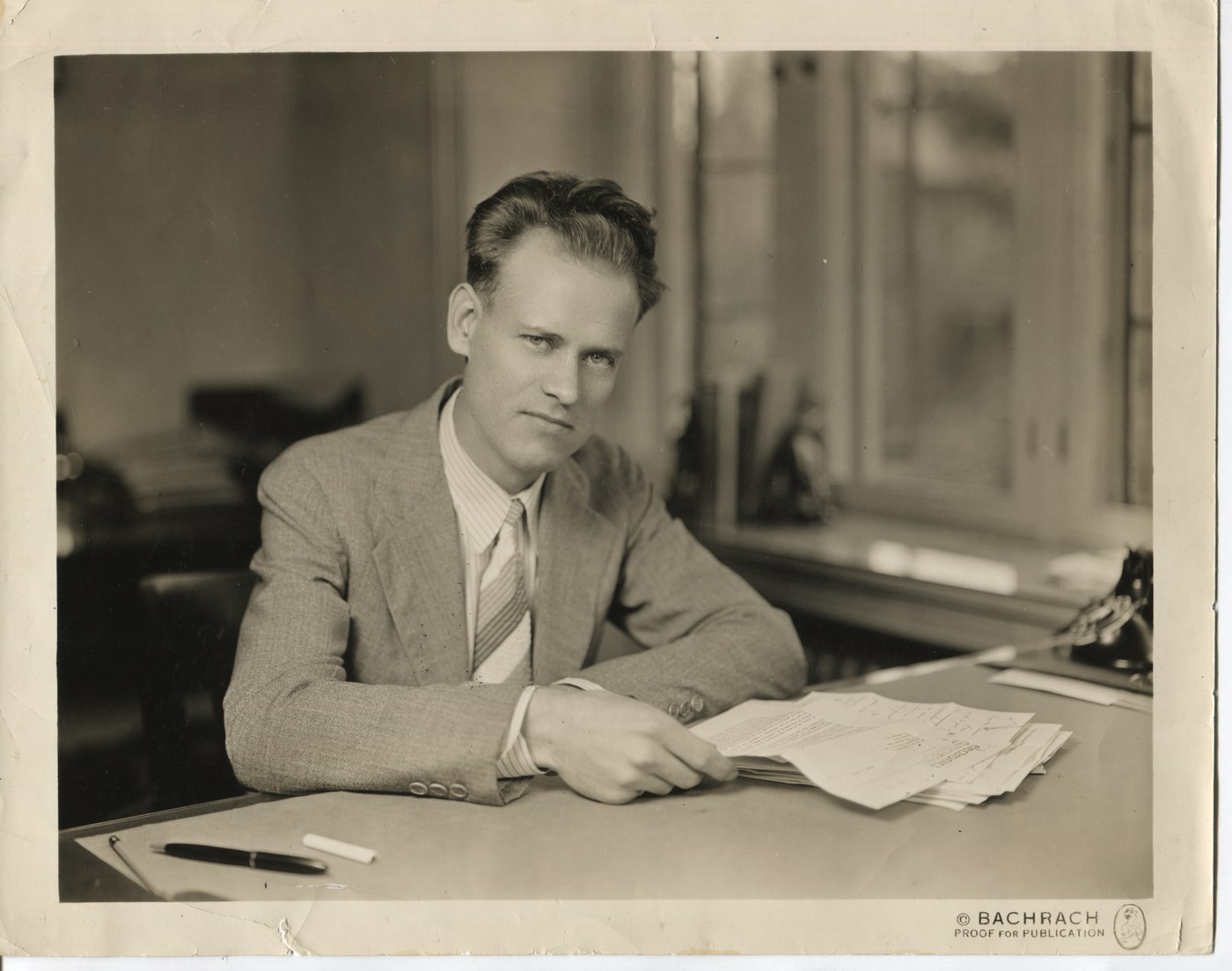
Early life
Philo Taylor Farnsworth was born on August 19, 1906, in a log cabin at Indian Creek, near Beaver in southwestern Utah. He was the eldest of five children of Lewis Edwin Farnsworth and Serena Bastian Farnsworth, and was named for his grandfather, a Mormon pioneer who had built the family’s log home in 1856 when he settled the area at Brigham Young’s request.
The family farmed, and money was always short. There was no electricity in the house, but the boy was drawn to anything mechanical, and he took apart whatever he could get his hands on to see how it worked and build something new from the pieces.
In 1918 the family moved by covered wagon to a relative’s ranch near Rigby, Idaho, where his father hauled freight to make ends meet. The ranch ran on a Delco generator, the first electricity Philo had ever lived with, and the 11-year-old learned to keep it running. He read every science magazine he could find, and at 13 won a magazine prize for a theft-proof car ignition.
The field
Television in those years meant spinning disks with holes punched in them, mechanical systems that could never move fast enough to make a sharp picture. In the summer of 1921, working a field with a horse-drawn harrow, Farnsworth looked back at the rows he had cut and saw a way around the problem. A beam of electrons could sweep an image line by line, the way he was working the field, and do it with no moving parts at all.
He explained the idea to his high school chemistry teacher, Justin Tolman, filling a blackboard with diagrams and leaving Tolman a sketch in 1922. Tolman kept it. Thirteen years later it turned up in a patent case.
Backers and a lab
When his uncle’s farm was lost, the family moved to Provo, Utah, and Philo took classes at Brigham Young University. In January 1924 his father died of pneumonia, and Philo became the family’s main support. That year he also met Elma “Pem” Gardner. Working on a Community Chest fundraising drive in Salt Lake City, he met George Everson and Leslie Gorrell, two professional fundraisers who listened to his pitch and put up $6,000 to try it.
He married Pem on May 27, 1926, and the couple moved to California, where Pem worked in the lab beside him. By the end of the year Farnsworth had moved into a loft at 202 Green Street in San Francisco, at the foot of Telegraph Hill. On January 7, 1927 he filed his patent application for a complete electronic television system.
September 7, 1927
The camera tube Farnsworth built was the image dissector. It turned light into a stream of electrons and swept that stream past a single aperture, line by line, to make a signal. On September 7, 1927, with a glass slide painted with a single black line set in front of it, the image appeared on the receiver in the next room. When the slide was turned, the line on the screen turned with it. It was the first picture ever transmitted by a fully electronic system.
In 1928, when a backer asked when they would see some dollars from the work, Farnsworth put a dollar sign on the screen. The following year he transmitted the first live human image with the system: Pem, with her eyes shut against the bright lights.
The patent was granted on August 26, 1930 as U.S. Patent 1,773,980, with a companion patent for the receiving system issued the same day.
RCA
RCA’s David Sarnoff saw television as the business that would follow radio, and he had hired Vladimir Zworykin to build it. In 1930 Zworykin spent several days at the Green Street lab studying Farnsworth’s work. Sarnoff later offered to buy Farnsworth out. Farnsworth turned him down.
In 1931 Farnsworth went to Philadelphia to work with Philco, RCA’s main radio rival, and in 1933 set out on his own again as Farnsworth Television Incorporated. Meanwhile RCA filed a patent interference case in 1932, claiming that a 1923 Zworykin application came before Farnsworth’s invention. Farnsworth’s lawyers went back to Idaho and found Justin Tolman, who still had the 1922 sketch.
In 1935 the U.S. Patent Office awarded priority of invention to Farnsworth. RCA appealed and lost. Sarnoff was known for saying RCA collected royalties and did not pay them. In September 1939 RCA agreed to pay Farnsworth $1 million over ten years, plus license fees, for the use of his patents.
Showing the world
In the summer of 1934 the Franklin Institute in Philadelphia gave the public its first look at all-electronic television, with live demonstrations that ran for days. That year Farnsworth also traveled to England and licensed his system to Baird Television. By 1936 his experimental station, W3XPF, was regularly broadcasting programs from outside Philadelphia.
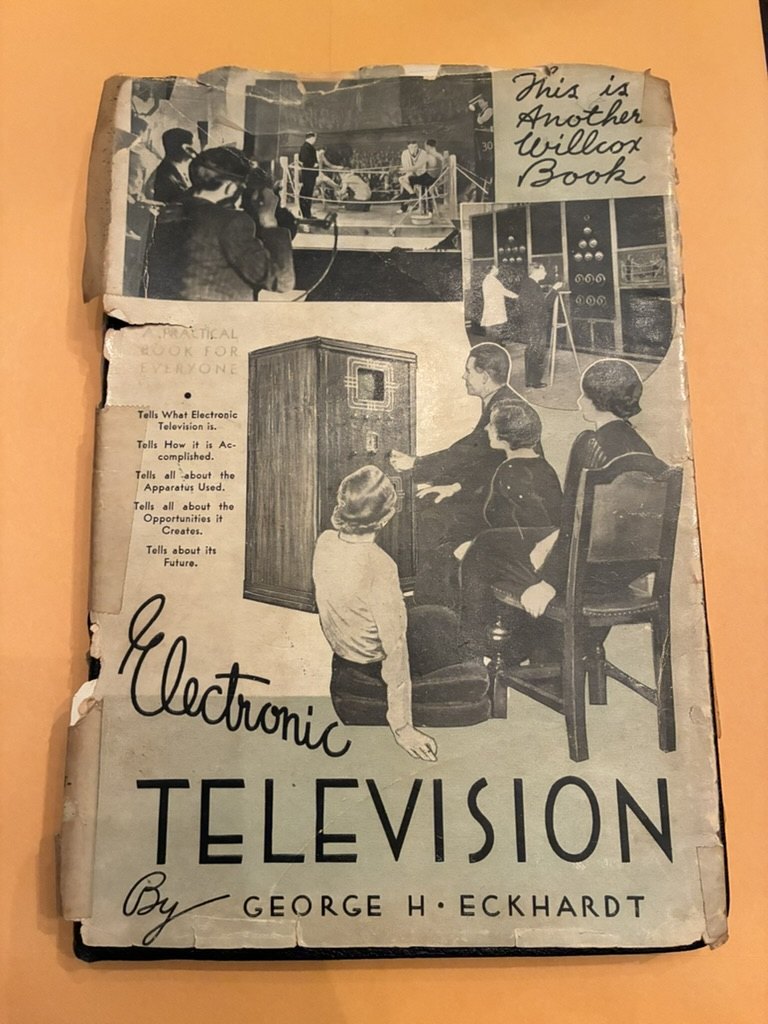
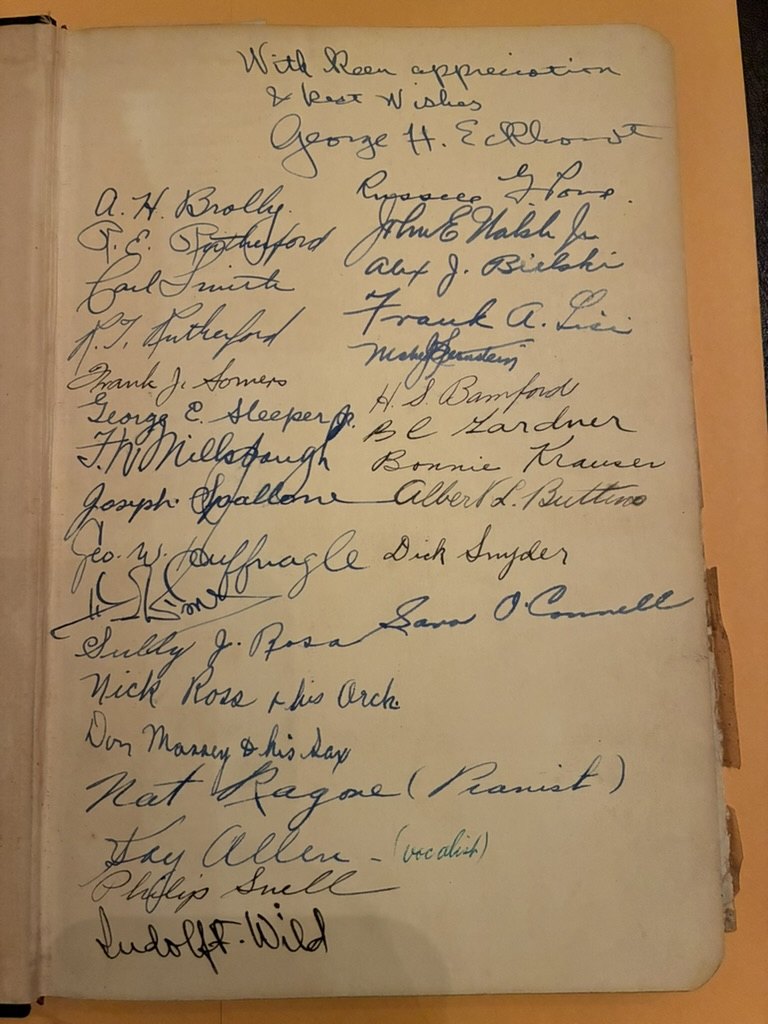
Philo’s own copy of George H. Eckhardt’s Electronic Television, Book No. 317, inscribed by the author and signed by the W3XPF crew. Estate archive.
In 1938 his backers reorganized the business as the Farnsworth Television & Radio Corporation and bought factories in Indiana to build sets. The war would decide what those factories made instead.
For a decade, the most powerful company in American broadcasting tried to prove that a young man from Idaho had not invented television. In 1935 the Patent Office ruled that he had.
Recognition
Farnsworth’s key patents expired in the late 1940s, just as television sales took off. He was rarely seen on the medium he created. One exception came in 1957, when he appeared as a mystery guest on the quiz show I’ve Got a Secret and none of the panelists guessed who he was. In 1990 Utah placed his statue in the U.S. Capitol’s National Statuary Hall.